How Much Does Jewelry Photo Retouching Cost? A Complete Pricing Guide (2026)
If you sell jewelry online, high-quality product images are no longer optional—they're essential. Whether you're running a Shopify store, selling on Etsy, Amazon, eBay, or your own eCommerce website, your photos play a major role in attracting customers and increasing conversions.
However, even the best jewelry photographs often require professional retouching before they're ready for publication. Tiny dust particles, fingerprints, scratches, reflections, color inconsistencies, and lighting imperfections can reduce the perceived value of your products.
That's where jewelry photo retouching comes in.
One of the most common questions jewelry businesses ask is, "How much does jewelry photo retouching cost?" The answer depends on several factors, including image complexity, editing requirements, turnaround time, and whether you hire a freelancer, an agency, or build an in-house editing team.
In this guide, we'll break down average jewelry photo retouching costs, explain what affects pricing, and help you determine which option offers the best value for your business.
Why Jewelry Photo Retouching Matters
Jewelry is one of the most difficult products to photograph because of its highly reflective surfaces and intricate details.
Even under professional studio lighting, raw images often contain:
- Dust particles
- Fingerprints
- Tiny scratches
- Unwanted reflections
- Uneven lighting
- Color inaccuracies
- Background distractions
Professional retouching transforms these images into polished product photos that highlight the craftsmanship, brilliance, and quality of each piece.
High-quality jewelry images can help:
- Increase customer trust
- Improve click-through rates
- Boost online sales
- Reduce product returns
- Strengthen your brand image
- Create consistency across your catalog
For luxury brands, retouching is an investment in presentation and customer perception.
What Is Included in Jewelry Photo Retouching?
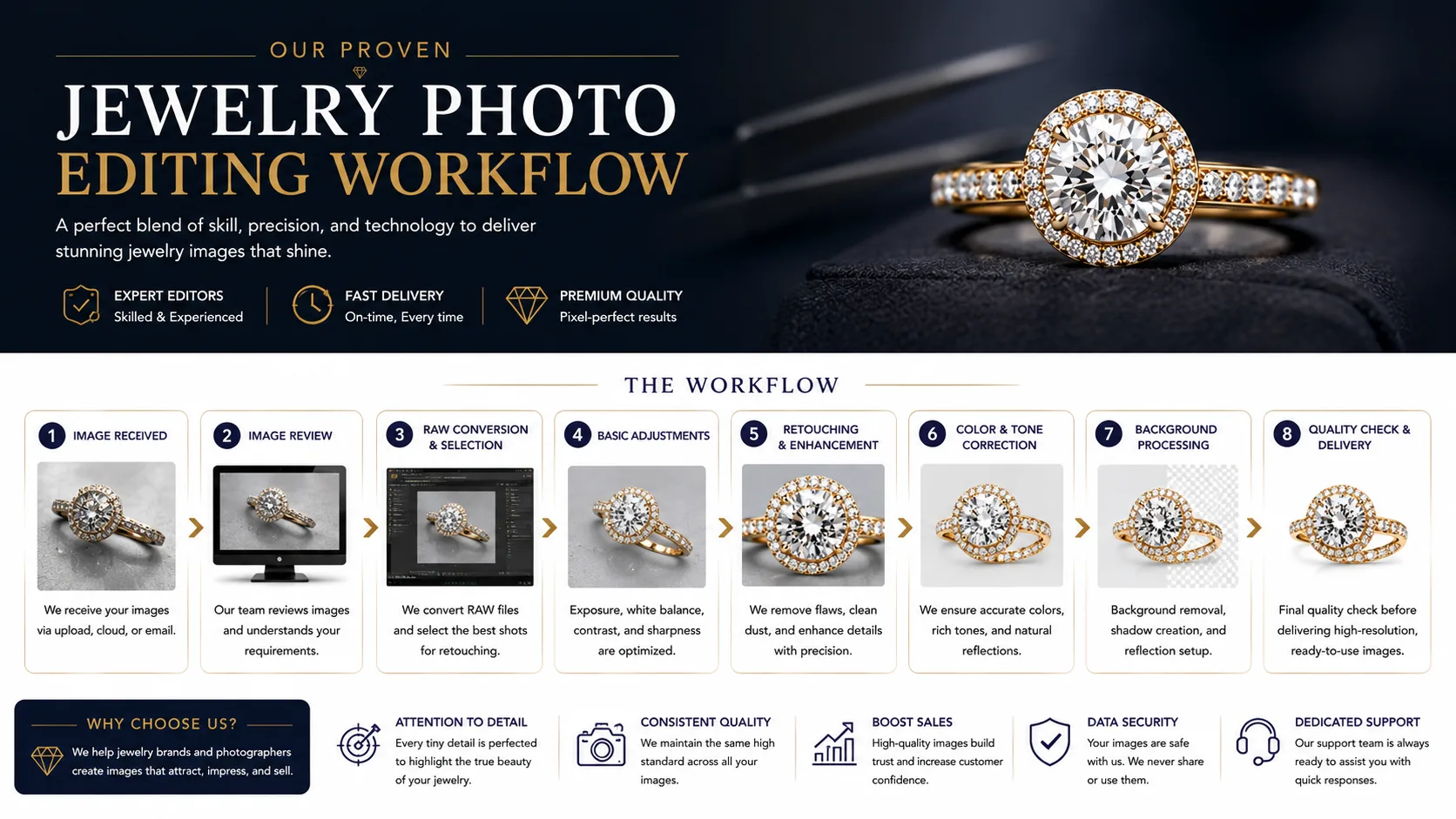
Not all retouching services are the same. Some providers offer basic corrections, while others specialize in high-end luxury jewelry editing.
Typical services include:
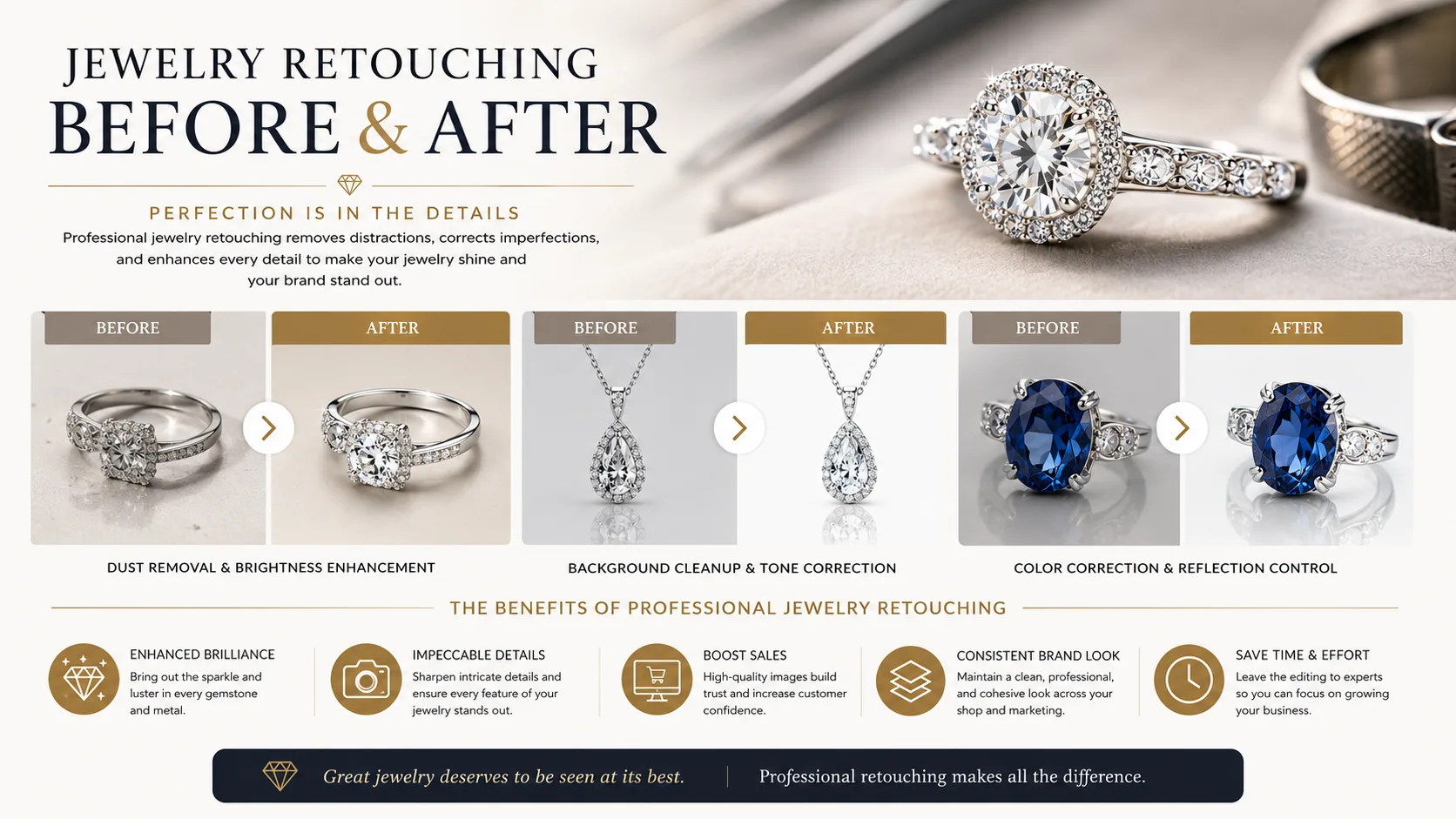
Dust and Scratch Removal
Editors carefully remove:
- Dust
- Fingerprints
- Surface scratches
- Lint
- Smudges
This gives jewelry a clean, flawless appearance.
Background Removal
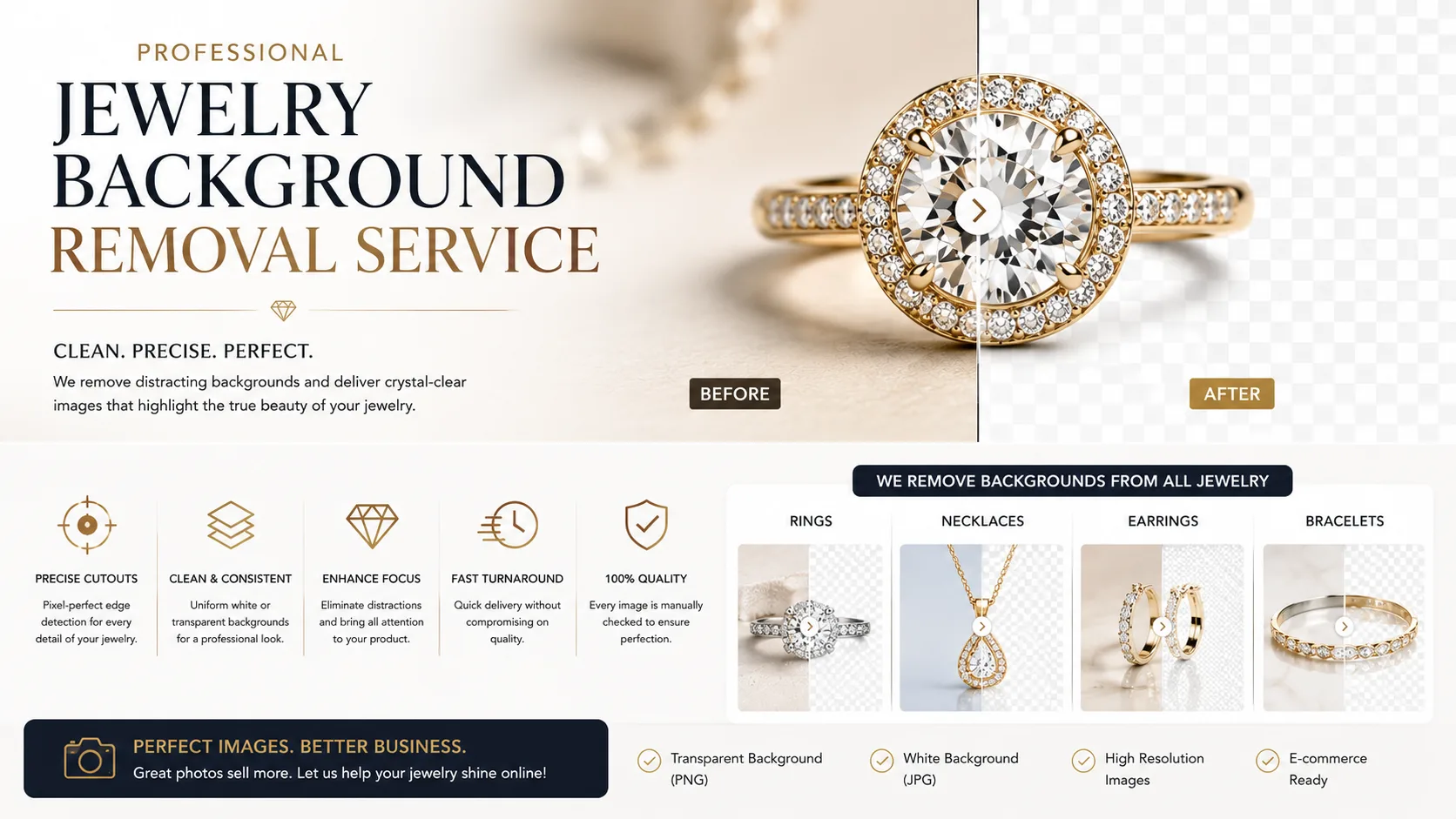
Background removal is one of the most commonly requested retouching services because major eCommerce marketplaces — including Amazon, Etsy, and Shopify — require clean, distraction-free product images. A cluttered or inconsistent background reduces the perceived quality of your jewelry and can cause listings to be rejected.
Professional editors use clipping paths and advanced masking techniques to isolate every detail of the jewelry — including delicate chains, fine prongs, and transparent gemstones — before placing the piece on a new background.
Common background options include:
- Pure white (#FFFFFF) — the standard for Amazon and most product catalogs
- Transparent (PNG) — ideal for website banners, marketing composites, and overlays
- Black or dark gray — popular for luxury brands and high-end advertising
- Custom lifestyle backgrounds — placing jewelry on fabric, marble, or branded scenes for social media and lookbooks
Automatic background removal tools often struggle with jewelry because of intricate edges and transparent stones. Professional hand-cut paths ensure clean, artifact-free results that look natural at any zoom level.
Color Correction
Accurate color reproduction is one of the most critical elements of jewelry retouching. When a customer sees a ring online, they expect the product they receive to match the photograph exactly. Color inaccuracies are one of the top reasons for jewelry returns in eCommerce.
Professional editors adjust:
- White balance — correcting warm or cool color casts introduced by studio lighting
- Exposure — ensuring the image is neither too bright nor too dark
- Contrast — separating light and dark tones for visual depth
- Saturation and vibrance — making colors appear rich without looking artificial
- Highlights and shadows — recovering detail lost in bright reflections or dark crevices
The goal is to ensure gold looks gold, silver looks silver, and gemstones display their natural colors. For catalog consistency, editors often create color profiles for each metal type so that every yellow gold piece in your collection shares the same warm tone.
Reflection Cleanup
Jewelry is one of the most reflective product categories to photograph. Polished metal surfaces act like tiny mirrors, capturing everything in the studio environment:
- Cameras and lens hoods
- The photographer and their clothing
- Windows, ceiling panels, and walls
- Light stands and softbox edges
- Other studio equipment
Professional editors carefully remove these unwanted reflections using clone stamping, frequency separation, and targeted brush work — all while preserving the realistic highlights that make metal look genuinely polished. The skill lies in knowing which reflections to remove and which to keep; stripping away every reflection makes the piece look flat and unrealistic.
Gemstone Enhancement
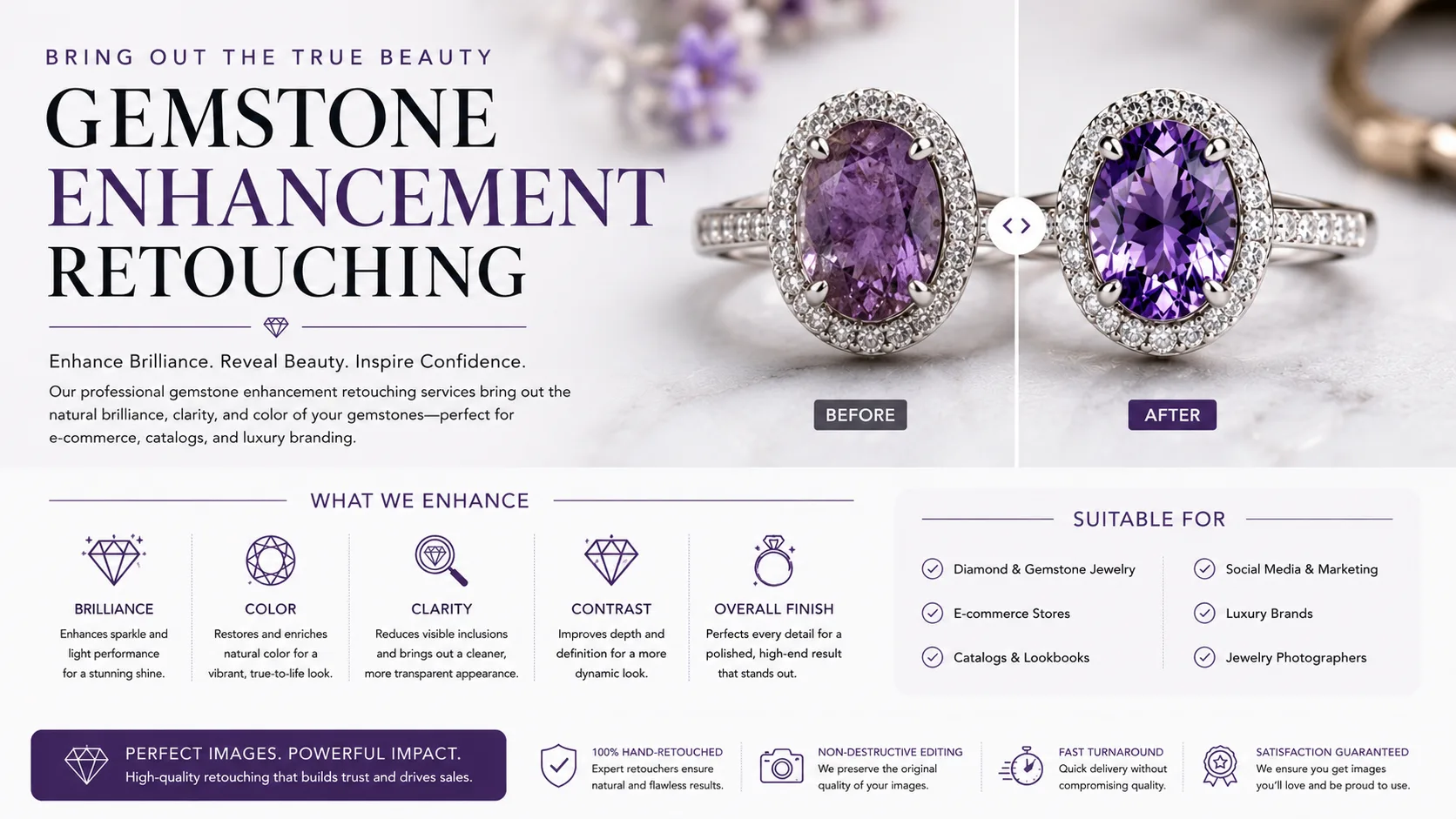
Cameras rarely capture diamonds, sapphires, or emeralds the way your eyes perceive them in person. Professional retouchers selectively enhance gemstone brilliance by adjusting clarity, contrast, highlights, and color vibrancy within the stone itself — without touching the surrounding metal.
The objective is to amplify the natural fire and scintillation already present in the photograph rather than adding artificial sparkle effects. Experienced editors understand how different stone types refract light: a round-brilliant diamond needs a different treatment than a cabochon-cut opal or a step-cut emerald. This precision is one reason stone reconstruction retouching is priced separately from basic color correction.
Metal Polishing
Gold, platinum, and silver surfaces are digitally polished by reducing surface imperfections, evening out reflections, and smoothing blemishes — all while maintaining the realistic texture that makes metal look genuine. Over-smoothing is a common amateur mistake that makes precious metals appear plastic.
Professional editors use frequency-separation techniques and targeted dodge-and-burn adjustments to keep the metallic grain intact. Yellow gold should retain its warm luster, white gold and platinum should appear cool and neutral, and rose gold should maintain its distinctive blush. Our metal smoothing service is specifically designed for this level of detail work.
Shadow Creation
After the background is removed, jewelry can appear to float unnaturally unless a realistic shadow is added back. Natural-looking shadows anchor the product visually and give it a three-dimensional, premium feel.
Common shadow styles include:
- Natural contact shadows — subtle darkening where the piece touches the surface, ideal for product catalogs
- Soft drop shadows — a gentle shadow beneath the jewelry that adds depth without distraction
- Reflection shadows — a mirror-like reflection beneath the piece, popular for luxury and advertising imagery
- Studio-style shadows — replicating the look of professional studio lighting for editorial consistency
Our drop shadow and mirror effect service creates shadows that complement your lighting setup and brand aesthetic.
Average Jewelry Photo Retouching Costs
Pricing varies significantly depending on image complexity and the quality of service you require. However, understanding typical industry rates helps you budget accurately and evaluate quotes from different providers.
Below are common price ranges based on service level:
Basic Retouching ($2 — $8 per image)
Basic retouching covers foundational corrections that prepare images for online listings. This tier typically includes background removal, exposure correction, cropping, and basic color correction. It is suitable for simple jewelry pieces such as plain bands, stud earrings, and minimalist pendants that require little detail work.
Standard Retouching ($8 — $25 per image)
Standard retouching adds dust and reflection removal, metal polishing, gemstone enhancement, and natural shadow creation. Most jewelry businesses fall into this category. The editor spends more time on each image to ensure metals look polished and stones display realistic sparkle.
High-End / Luxury Retouching ($25 — $75+ per image)
Luxury retouching is designed for premium brands, auction houses, and advertising campaigns. Services include composite editing, focus stacking, gemstone replacement, reflection reconstruction, and pixel-level detail work. Each image may take 30 minutes to several hours of editing time.
Bulk and Subscription Pricing
Many retouching studios — including Jewelry Photo Magic — offer volume discounts that can reduce per-image costs by 30 to 50 percent. If you regularly photograph new collections, a monthly subscription or bulk package often delivers the best value. For example, a 500-image order might bring the per-image cost down to $3 — $5 for standard edits, compared to $12 — $15 for a one-off order of 20 images.
| Service Level | Typical Price Per Image |
|---|---|
| Basic editing | $2–$5 |
| Standard retouching | $5–$15 |
| Advanced jewelry retouching | $15–$40 |
| High-end luxury retouching | $40–$100+ |
Basic editing generally includes cropping, exposure correction, and simple background removal.
Advanced retouching may involve extensive dust removal, gemstone enhancement, reflection cleanup, and precise color correction.
Luxury jewelry brands often require meticulous hand retouching that can take one to several hours per image, especially for metal polishing and smoothing.
Factors That Affect Jewelry Photo Retouching Costs
Several variables influence the final cost of professional retouching.
Complexity of the Jewelry
Simple products like plain wedding bands require much less editing than elaborate necklaces with dozens of gemstones.
Highly detailed pieces often demand additional time for:
- Reflection cleanup
- Gemstone enhancement
- Fine edge selection
- Metal polishing
The more intricate the jewelry, the higher the editing cost.
Number of Images
Most retouching companies offer discounts for bulk orders.
For example:
- 20 images typically cost more per image than 500 images.
- Large product catalogs often qualify for volume pricing.
If you photograph new collections regularly, ask about long-term pricing packages.
Turnaround Time
Rush orders almost always cost more.
Typical turnaround options include:
- Standard (24–72 hours)
- Express (12–24 hours)
- Same-day delivery
Planning your photography schedule in advance can help reduce unnecessary rush fees.
Level of Retouching
Basic editing requires far less time than luxury retouching.
Some projects only need:
- Background removal
- Exposure correction
- Cropping
Others require advanced services such as:
- Composite editing
- Focus stacking
- Gemstone replacement
- Reflection reconstruction
- High-end beauty retouching
More labor-intensive work naturally increases pricing.
Experience of the Editor
Freelancers, boutique studios, and specialized jewelry retouching agencies all have different pricing structures.
Experienced editors often charge higher rates because they deliver:
- Better consistency
- Faster turnaround
- Higher-quality results
- Greater attention to detail
Paying slightly more for experienced professionals can often reduce revisions and improve overall image quality.
DIY vs. Professional Jewelry Photo Retouching
Many small businesses initially edit their own jewelry photos to save money. While this approach can work for small catalogs, it is important to weigh the true costs — including your time — before deciding.
DIY Editing
Advantages
- Lower upfront costs if you already own editing software
- Complete creative control over the final look
- Immediate revisions without waiting for a provider
- No outsourcing delays for small, urgent edits
Disadvantages
- Time-consuming — even a simple ring can take 20 to 45 minutes to retouch properly, which adds up quickly across a full catalog
- Steep learning curve — mastering clipping paths, frequency separation, and gemstone enhancement takes months of practice
- Software costs — Adobe Photoshop runs approximately $22/month, and you may also need Lightroom, Capture One, or specialized plugins
- Inconsistent quality — without professional training, results vary from image to image, weakening your brand presentation
- Opportunity cost — hours spent editing are hours not spent on sales, marketing, or product development
Professional Retouching
Advantages
- Consistent, catalog-ready quality across every image
- Faster turnaround — most studios deliver within 24 to 48 hours
- Access to specialized techniques like gemstone replacement and reflection reconstruction
- Scalable — handles 10 images or 10,000 without adding to your workload
Disadvantages
- Per-image cost adds up for very large catalogs (though volume discounts help)
- Requires clear communication of your brand style and preferences
- Initial back-and-forth to align on editing expectations
The bottom line: if you process fewer than 20 images per month and enjoy editing, DIY can be cost-effective. Beyond that threshold, the time savings and quality consistency of professional retouching almost always deliver a better return on investment.
How to Choose a Jewelry Photo Retouching Service
Not all photo editing providers specialize in jewelry. Since jewelry is one of the most technically demanding product categories, it's important to choose a company with relevant experience.
Before hiring a retouching service, consider the following:
Review Their Portfolio
Examine before-and-after examples to evaluate:
- Detail preservation
- Natural-looking edits
- Accurate color reproduction
- Clean background removal
- Consistent image quality
A strong portfolio is often the best indicator of the editor's skill.
Ask About Turnaround Time
If you regularly launch new collections or update product listings, reliable turnaround times are essential.
Discuss:
- Standard delivery times
- Rush order availability
- Revision policies
- Batch processing capabilities
Compare Pricing and Value
The lowest price isn't always the best choice.
Consider the overall value, including:
- Editing quality
- Communication
- Reliability
- Consistency
- Customer support
High-quality retouching can have a direct impact on how customers perceive your jewelry, making it worth investing in experienced professionals.
Cost-Saving Tips for Jewelry Photo Retouching
Professional jewelry retouching doesn't have to strain your budget. With the right workflow and planning, you can reduce editing costs while maintaining high-quality product images.
Photograph Jewelry Correctly
The cleaner your original images, the less editing they'll require.
Before photographing your products:
- Clean every jewelry piece with a microfiber cloth.
- Remove fingerprints and dust.
- Use soft, diffused lighting.
- Position jewelry carefully to minimize reflections.
- Use a tripod for sharper images.
- Capture images in RAW format whenever possible.
Better source images reduce editing time and often lower retouching costs.
Batch Similar Products Together
If you're photographing an entire collection, keep your camera settings, lighting, and backgrounds consistent.
This consistency allows editors to streamline their workflow and may qualify you for volume discounts.
Order in Bulk
Many jewelry photo editing companies offer lower per-image pricing for larger projects.
For example:
- 20 images may cost $12 per image.
- 500 images may cost $5 per image.
If you launch seasonal collections, consider batching multiple products into one editing order.
Clearly Define Your Editing Requirements
Avoid unnecessary revisions by providing clear instructions from the beginning.
Specify details such as:
- Background color
- Shadow style
- Image dimensions
- File format
- Color preferences
- Marketplace requirements
A detailed editing brief saves both time and money.
Build a Long-Term Relationship
Working with the same editing team over time has several advantages:
- Consistent editing style
- Faster communication
- Better understanding of your brand
- Potential loyalty discounts
- More efficient workflows
Long-term partnerships often provide better value than switching providers for every project.